In India, the product certification system was introduced in 1955 to harmonize product regulatory standards and requirements and to ensure product quality and safety. Where included in the mandatory certification of products, are required to obtain product certification according to Indian product standards to enter the market. Therefore, want to enter the Indian market manufacturers, it is necessary to have an understanding of the Indian product certification system.
India's product certification organization according to the Indian Parliament "Bureau of Indian Standards Act 1986", the Bureau of Indian Standards (TheBureauofIndianStandards, referred to as BIS) is specifically responsible for product certification, it is also the only product certification body in India. 5 regional bureaus and 19 sub-bureaus are set up under the BIS. BIS has 5 Regional Bureaus and 19 Sub-Bureaus, which are supervised by the Regional Bureaus. 8 laboratories under BIS and some independent laboratories are responsible for the testing of samples taken during the product certification process. All these laboratories operate under ISO/IEC 17025:1999.
Product certification in India has a history of 50 years since 1955, when the predecessor of BIS, the Bureau of Indian Standards (BIS), started product certification. At present, BIS has issued more than 30,000 product certification certificates covering almost every industrial sector such as agricultural products, textiles and electronics.
BIS Certification Mark
Procedure for Product Certification in India Procedure for grant of BIS Product Certification Certificate
(i) Application. Fill in the special application form and pay the application fee to the BIS branch office of the legal location of the factory premises. In addition to the special application form, you need to submit the following documents: 1. factory location and factory map; 2. production plant documents; 3. existing production equipment and inspection equipment list; 4. being used or proposed to use the test and inspection program, together with the granting of the certificate to comply with the test and inspection program recognized by the BIS letter of commitment; 5. from the date of the granting of the certificate to pay the prescribed marking fees letter of commitment; 6. compliance with the terms of all conditions for the granting of the certificate and in the event of suspension or suspension of the certificate, or in the event of the granting of the certificate of commitment letter. All terms and conditions of the grant of the certificate together with a letter of commitment to suspend the use of the mark immediately upon suspension or revocation of the certificate; 7. A flow chart describing the production and inspection steps; 8. Details of the available technical staff.
(ii) Records. Upon detailed examination, if the application formalities are complete, the BIS will record the application and assign an application number to the applicant, and the application is thus established.
(iii) Initial Inspection. The conformity of the product with the Indian Standards is determined by evaluating the company's production capacity and level of control, quality control techniques, available equipment, staff skills, and sample testing.
(iv) Issuance of Certificate. If the results of the initial inspection and sample testing fulfill the conditions, a certificate will be issued to the applicant. The certificate will be valid for a period of 2 years. If the certificate is executed correctly, it can be extended for two years at a time upon application. If the licensee wishes to expand the scope of products covered by the same standard of the certificate, after routine testing, the conditions can be changed. If the certificate expires, depending on the validity of the certificate can be updated within the implementation of the certificate.
(E) post-certification supervision. After the granting of the certificate, if the licensee to perform all the testing and inspection program, the product is consistent with the Indian standard, the sample test records remain intact, authorized by the product can be stamped with the logo. The applicant is required to pay a marking fee.
BIS will conduct regular supervision and inspection of the licensee on the implementation of the certificate. Such supervision and inspection mainly looks at whether the testing and inspection program is completely fulfilled and whether the quality control system is strictly implemented in accordance with the technical standards. Production samples are also tested and the samples taken are sent to BIS or an independent laboratory for testing.
The results of regular inspections and product testing are communicated to the licensee in an appropriate manner. In case of persistent non-conformity, the use of the mark on the product will be suspended. If both the periodic inspection and product testing are not in compliance with the requirements, especially with the Indian standards, BIS will decide to suspend the use of the mark or revoke the licensee's certificate outright, depending on the situation.
The first batch of mandatory product catalog
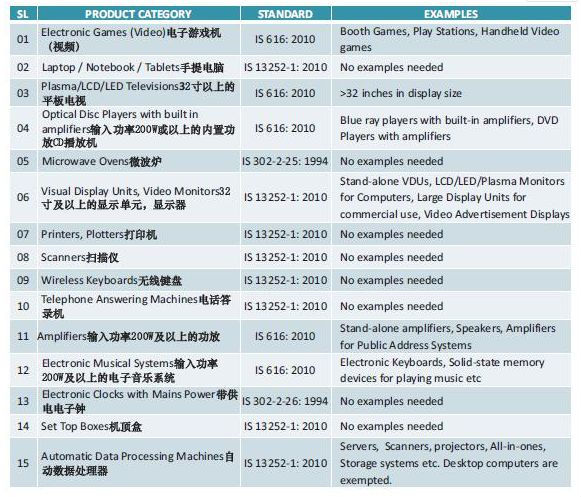
India's Department of Electronics and Information Technology (Departmentof Electronics and Information Technology) issued the Electronics and Information Technology Products (Compulsory Registration Requirements) Order. The Order stipulates that from April 3, 2013, the following 15 categories of home appliances and information technology products will be required to undergo testing to specified standards and be registered at a BIS-accredited laboratory; and to be labeled with the words "Self-declaration of Conformity to IS Standards" either on the product itself or on the outer box, in order to be allowed to enter the Indian market.
Second Batch of Mandatory Product Catalog
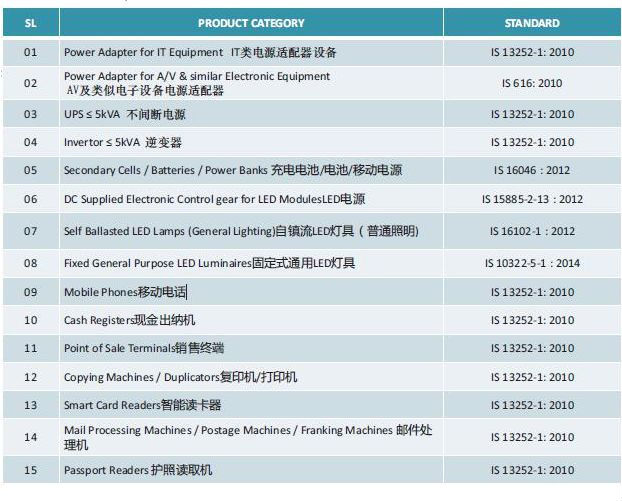
The Department of Information Technology (DEITY) of India has officially issued a notification on November 7, 2014 that the Electronic and Information Technology Products (Mandatory Registration Requirements) Order, 2012 has added 15 new categories of regulated products, including power adapters for IT and AV products, uninterruptible power supplies (UPS) ≤ 5kVA, mobile power supplies, LED lights, cell phones, photocopying machines, and cash dispensers, etc. (Please refer to the following table for detailed information on the products). (Please refer to the following table for detailed product information).
The effective date of the mandatory registration requirements for the new products is specified in the announcement:
00001. The implementation buffer period for secondary batteries/batteries/mobile power supplies using alkaline or non-acidic battery fluids in portable devices (Item 20) is 9 months and will be effective from August 7, 2015 onwards;
00002. the implementation buffer period for the mandatory registration of BIS for the remaining products is 6 months from the date of the announcement, which will be officially effective on May 7, 2015
BIS Certification Process
1>Confirmation of contract
2>Payment
3>Submit samples and information
4>Pre-testing
5>Submit final samples and information to BIS designated organization
6>Final test
7>Provide report from designated organization
8>Provide report and BIS registration information
9>Complete registration and obtain registration number and certificate.
Required documents for BIS certification
1. English manual of the product
2. Schematic diagram and PCB diagram of the whole machine.
3.CDF (according to the product, accept UL or CB and other certificates)
4. External power adapter schematic diagram, PCB drawing
5 external power adapter CB report and certificate Note: May 7, not accepted after the mandatory provision of BIS certification
6. Lithium batteries or battery core CB report and certificate
7. Product nameplate
8. Detailed specifications of lithium batteries (including protection circuit schematic)
9. Provide a description of the differences, the series of applications when applicable
Note: The power cord needs to meet the IS302-1, plug pins need to meet the IS1293.
Cautions
1>Series application, the model number can not be more than 10 per report
2> Nameplate
Need to add: Self Declaration - Conforming to IS (Standard no.), R-xxxxxxxxxxx
BIS Certification Requirements
Write the phrase Self Declaration above or below the logo. The sentence should be in 12-point font, or one-quarter the size of the logo if there is not enough space. XXXXXXXXXX after R- indicates that a BIS registration number will be obtained, and the 8-digit registration number will be filled in after the certificate is issued.
Other contents at least fill in the contents of the illustration can be. Other contents can be arbitrary. Fill out the application for a series of multiple nameplates, then you need to provide multiple copies of the nameplate drawings and objects.
The manufacturer must have a representative office or agent in India.
Tests must be conducted in India
Test report must be submitted within 90 days of application.
The manufacturer must rectify the non-conformities within 7 working days, otherwise the application will be rejected by BIS.
Certificate is valid for two years
BIS Certification Cycle
Testing Cycle: 4-5 weeks
Registration cycle: 2-3 weeks