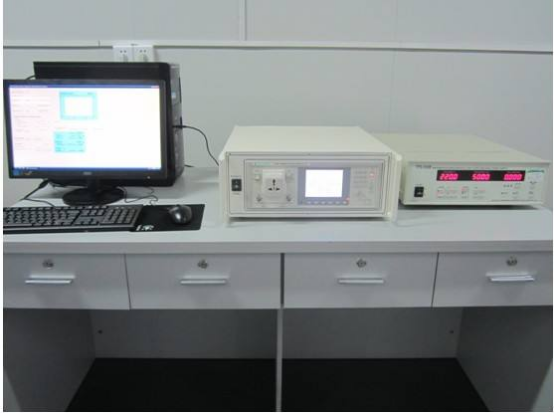
Flicker and harmonic testing is another form of emissions testing. These EMC tests are usually performed according to the EN61000-3-2 and EN61000-3-3 standards, respectively. In Europe, these are considered "horizontal" standards, meaning that they apply to almost any electronic or electrical equipment entering the EU. There are many warnings about this, but you can use our EMC Test Standards Finder to see if these standards apply to you!
Harmonic Current Test (61000-3-2)
This test is designed to measure the harmonic current requirements of an EUT. It is typically associated with switch mode power converters and other non-linear loads such as motors, transformers and lamp dimmers/ballasts. By limiting the harmonic current draw requirement, the harmonic load on the local power supply is reduced, which helps avoid overheating and improves efficiency. Maintaining the quality of the AC distribution system is a major challenge for electric utilities.
Voltage Flicker Test (61000-3-3)
Flicker testing light bulbs for the first ever EMC test - limited in the 1890s in London, England. Lowering the lamp would cause an arc discharge between the contacts, which in turn would cause nearby lamps sharing the same power supply to "flicker". The impedance of the power wiring was much higher than it is today. The non-linear current draw of an arcing lamp causes a change in voltage on the power supply, which affects nearby lamps. Today's flicker limits are still actually related to the amount of visually perceptible flicker on an incandescent bulb.
Magnetic Field Testing
The magnetic field test is a very rare test, but some standards do require it. Magnetic fields are primarily present at lower frequencies and are usually measured using a large loop antenna placed very close to the EUT.