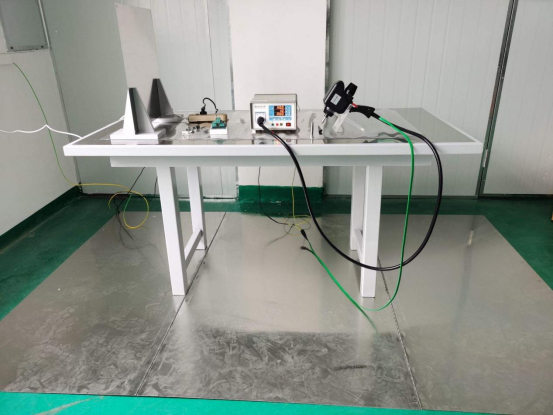
Electrostatic Discharge Immunity Test
Electrostatic discharge immunity test
Testing and measurment technitic discharge immunity test
1. Electrostatic discharge immunity test scope.
This standard specifies the electrical and electronic equipment subjected to electrostatic discharge directly from the operator and the neighboring objects of the immunity requirements and test methods, but also specifies the scope of the test level and test procedures in different environments and installation conditions.
2. Electrostatic discharge immunity test reference standard.
GB/T Electromagnetic compatibility terminology
IEC 68-1:1998 Environmental testing Part: General principles and guidelines
3. Electrostatic discharge immunity test overview
This standard covers the electrostatic discharge environment and installation conditions of the device. System. Sub-systems and external equipment. Subsystems and external equipment. For example, low relative humidity, the use of low conductivity (synthetic fiber) carpet. Vinyl clothing, etc.
4. Electrostatic discharge immunity test definition.
4.1 reduce degradation (of performance)
Device equipment or system performance and the normal performance of the non-expected deviation
4.2 electromagnetic compatibility (EMC) electromagnetic compatibility
Equipment or system in its electromagnetic environment can work normally and not to the environment of any thing constitute intolerable electromagnetic nuisance capacity
4.3 Antistatic material antistatic discharge
In the same kind of material or with similar material mutual friction or separation, has the generation of electric charge small amount of material
4.4 Energy storage capacitor energy storage capacitor
The capacitor in the electrostatic discharge generator, used to represent the human body charged to the test voltage value of the capacitance, it can be discrete components or distributed capacitance
4.5 ESD electrostatic discharge
Electrostatic discharge
4.6 EUT e under test
Equipment under test
4.7 Ground Reference Plane (GRP) ground reference plane
A conductive plane, the potential used as a common reference potential
4.8 coupling plane
A piece of metal or metal plate, on which the discharge is used to simulate the electrostatic discharge of objects in the vicinity of the equipment under test
HCP: horizontal coupling plate; VCP: vertical coupling plate
4.9 holding time
Before the discharge, due to leakage and the test voltage drop of not more than 10% of the time interval
4.10 electrostatic discharge ;ESD
With different electrostatic potential objects close to each other or direct contact caused by the charge transfer
4.11 immunity (of disturbance)
Device equipment or system facing electromagnetic harassment does not reduce the ability of operational performance
4.12 contact discharge method
A test method in which the electrodes of the test generator remain in contact with the test equipment and are excited to discharge by a discharge switch within the generator.
4.13 air discharge method
The test generator charging electrode close to the test equipment, and by the spark to the test equipment test equipment to stimulate the discharge of a test method
4.14 direct application
Direct application of discharge to the test equipment
4.15 indirect application
The coupling plate near the test equipment to implement the discharge, to simulate the personnel of the test equipment near the object of the discharge
5. Electrostatic discharge immunity test level.
Contact discharge is the preferred test method, air discharge is used where contact discharge cannot be used, the voltage of each test method is listed in Table 1, due to the difference in test methods, the voltage shown in each method is different. The degree of severity of the two test methods is not meant to be equal.
1a Contact discharge 1b Air discharge
Class Test voltage KV Class Test voltage KV
1 2 1 2
2 4 2 4
3 6 3 8
4 8 4 15
* Special * Special
6. Electrostatic discharge immunity test generator.
The test generator mainly includes.
Charging resistance R; Energy storage capacitor Cs; Distribution capacitance Cd; Discharge resistance Rd.
Voltage indicator; discharge head; replaceable discharge electrode head; discharge circuit cable; power supply device
6.1 Characteristics of Electrostatic Discharge Generators
Specification.
-------- Energy storage capacitance (Cs+Cd) 150pF±10%
-------- Discharge Resistor (Rd) 330ohm;±10%
------- Charging Resistance (Rc) Between 50Mohm;and 100Mohm;.
------- Output Voltage Contact Discharge 8KV ;Air Discharge 15KV
------- Output Voltage Tolerance ±5
------- Transmission voltage polarity Positive and negative
------- Holding time at least 5S
------- Discharge, operation mode Single discharge
The cable of the discharge circuit in the test generator is generally 2m long, and its composition should enable the generator to meet the requirements of the waveform, and it should be sufficiently insulated to prevent the current in the electrostatic discharge does not flow through its port to the personnel or conductive surfaces.
6.2 Calibration of the characteristics of the electrostatic discharge generator
Waveform Parameter : Waveform Parameter : Waveform Parameter : Waveform Parameter
Class 1 2 3 4
Indicated voltage KV 2 4 6 8
Peak current of discharge (±10%) A 7.5 15 22.5 30
Rise time at the beginning of discharge operation tr ns 0.7~1 0.7~1 0.7~1 0.7~1 0.7~1
Current at 30ns (±10%) A 4 8 12 16
Current at 60ns (±30%) A 2 4 6 8
7. Electrostatic Discharge Immunity Test Configuration
A) Contact discharge on conducting surfaces and on coupling planes.
B) air discharge on insulating surfaces.
7.1 Configuration for laboratory tests
The laboratory floor shall be provided with a ground reference plane, which shall be a small thickness of 0.25 mm copper or aluminum sheet metal, other metals can be used, but they have a thickness of at least 0.65 mm.
The small size of the grounding reference plane is 1 * 1m, the actual size depends on the size of the test equipment, and each side should be at least 0.5m out of the test equipment or coupling plate, and it will be connected to the protective earthing system.
The coupling plate shall be of the same metal and thickness as the earth reference plane and shall be connected to the earth reference plane by a 470 Ω resistor cable at each end, which resistors shall withstand the discharge voltage when the cable is placed on the earth reference plane and be well insulated to avoid short circuits to the earth reference plane.
7.1.1 Benchtop equipment
The test setup consists of a 0.8 m high wooden table placed on the grounded reference plane.
A horizontal coupling plate (HCP) measuring 1.6m*0.8m is placed on the EUT and a 0.5mm thick insulating liner is used to isolate the EUT and cables from the HCP.
If the EUT is too large to maintain a small distance of 0.1m from each side of the horizontal coupling plate, another piece of the same horizontal coupling plate should be used, and with the short side of the block distance of 0.3m. But this time, the table must be expanded or the use of two tables, these horizontal coupling plate must be welded together, and through another resistive cable to the grounding reference plane
7.1.2 Floor-mounted equipment
The test equipment and cables are separated from the ground reference plane by an insulated support with a thickness of approx. 0.1 m.
8. Electrostatic discharge immunity test program
8.1 Climatic conditions.
------- Ambient temperature: 15℃~35℃.
------- Relative Humidity: 30%~60
------- atmospheric pressure: 86Kpa~106Kpa
8.2 Examination of test equipment
8.3 Implementation of the test
8.3.1 Discharge applied directly to the test equipment
The electrostatic discharge is applied only to the points and surfaces that may be contacted by the operator during normal use of the test equipment.
In order to determine the critical value of the fault, the test voltage shall be increased gradually from a small value to a selected test voltage value, the latter not exceeding the product specification value, so as to avoid damage to the equipment.
The test shall be carried out as a single discharge. At least ten single discharges (sensitive polarity) shall be applied at preselected points.
The time interval between successive single discharges is recommended to be at least 1S, but longer intervals may be required to determine whether a system failure will occur.
The electrostatic discharge generator should be kept perpendicular to the surface on which the discharge is applied to improve the repeatability of the test results.
The discharge circuit cable of the generator should be at least 0.2 m away from the test equipment when the discharge is applied.
In the case of contact discharges, the tip of the discharge electrode shall be in contact with the test equipment before the discharge head is operated.
For painted surfaces, the following procedure shall be used.
If the equipment manufacturer does not specify that the paint film is an insulating layer, the electrode tip of the generator shall be inserted into the paint film in order to make contact with the conductive layer, or, if the manufacturer specifies that the paint film is an insulating layer, the air discharge shall be performed only. Such surfaces shall not be subjected to a contact discharge test.
In the case of air discharges, the round discharge head of the discharge electrode shall be brought as close as possible to, and re-touch, the test equipment. After each discharge, the discharge electrode of the electrostatic discharge generator shall be removed from the test equipment, and the generator shall be re-triggered to perform a new single discharge, and the procedure shall be repeated until the discharge is complete, and, in the case of the air-discharge test, the opening of the discharge head used for contact discharges shall be closed. .
8.3.2 Indirectly applied discharges
8.3.2.1 Horizontal coupling plates under the test equipment
At least 10 single discharges shall be applied to the horizontal coupling plate at points on each side of the test equipment.
The electrostatic discharge generator shall be placed vertically at a distance of 0.1 m from the test equipment if the discharge electrode touches the coupling plate.
8.3.2.2 Vertical coupling plates
At least ten single discharges shall be applied to the center of one of the vertical sides of the coupling plate, and the coupling plate, with dimensions of 0.5m*0.5m, shall be placed parallel to the test equipment and at a distance of 0.1m from it.
Discharge should be applied to the coupling plate, by adjusting the position of the coupling plate, so that the test equipment on all sides of different positions are subjected to discharge test.