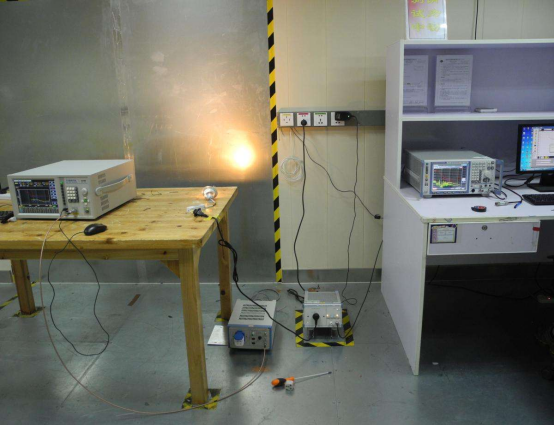
Conducted Emission
Conducted Emission (Conducted Emission) test, often referred to as nuisance voltage test, as long as there is a power line of the product will be involved, including many DC-powered products, in addition, the signal/control line in a number of standards also have the requirements of the Conducted Emission, usually with the nuisance voltage or nuisance current limits (the two have a mutual conversion relationship) to express the lamps and lanterns in the Insertion loss test (expressed directly in dB) also belongs to the category of Conducted Emission test. Insertion loss tests (expressed directly in dB) in luminaires also fall into the category of conducted tests.
Standards
Most European standards will be based on international standards from CISPR (Special Committee on Radio) and IEC (International Electrotechnical Commission).
The test methods are given in the relevant standard CISPR 16-2 (GB6113.2).
Product-specific standards:
CISPR11- Industrial Scientific Medical Equipment
CISPR14- Household appliances and portable tools
CISPR15- Lamps
CISPR22- Information technology equipment
EN61800- Motor speed control equipment
EN12015- Elevators
Characteristics and frequency range
Conduction through cables
150 kHz to 30 MHz (from 9 kHz in some standards)
Test equipment
Measurement receiver
EMI test receiver according to CISPR 16-1.
The EMI receiver, also called EMI meter, is the most widely used and basic measuring instrument for electromagnetic compatibility testing.
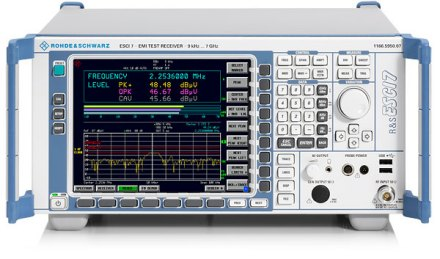 R&S ESCI EMI test receiver
Most of the receivers on the market are Rohde & Schwarz (Rohde & Schwarz), Narda PMM series, Italy AFJ, Beijing Teseq (the original Schaffner's), Agilent's have been applied.
Artificial Power Networks
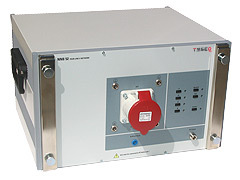
TESEQ LISN
Line Impedance Stabilizing Network Conforms to CISPR16-1LISN Line Impedance Stabilizing Network
Isolates grid interference, provides stable test impedance and acts as a filter. There are many manufacturers of artificial power supply networks, with Schwarzbeck, R&S, TESEQ using the majority.
Voltage Probes
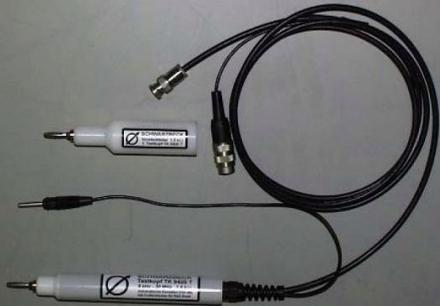
Schwarzbeck voltage probe
If the rated current of the equipment is too high and there is no suitable LISN available, it is also possible to measure the nuisance voltage at the power supply side directly with a voltage probe. Manufacturers such as R&S, Schwarzbeck, Narda and others.