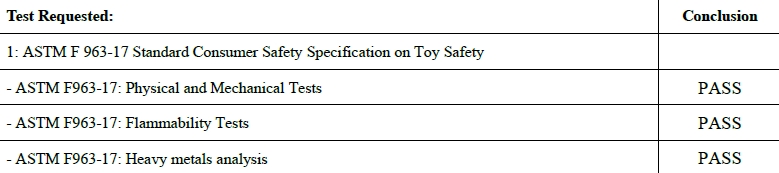
ASTM F963 standard on the physical and mechanical properties of the requirements are mainly related to: impact test, drop test, tensile test for component removal, pressure test, flexural test and so on.
Toy flammability test program in accordance with the requirements of 16CFR 1500.44, the toy for the horizontal combustion, and the provisions of the toy after the fire along the main axis of the self-burning speed should be as low as 2.5mm / s. The toy should not be used as a toy, but should be used as a toy, and should not be used as a toy.
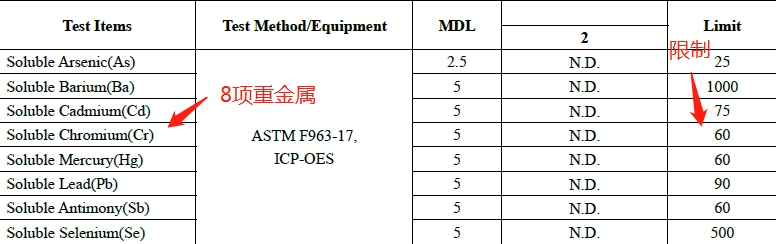
The ASTM F963-07 chemical test for heavy metal content is different from EN71-3 in that it does not require a lot of material testing, only surface coating testing. If a toy does not have a surface coating, it is not necessary to do the test of the 8 elements; if there is a surface coating, it is necessary to do two tests: one is to do the test of the eight heavy metal elements (antimony, arsenic, barium, cadmium, chromium, lead, mercury, selenium), and the other is to do the test of total lead.
ASTM F963-17 
Published by ASTM December 2011
Supported unanimous adoption by CPSC in March 2012
Became mandatory rule in June 2012
Updated to ASTM F963-17 by the end of 2017 and in use today.
F963 Heavy Element
Surface coating restrictions typically apply for 14.
years; substrate requirements typically apply to accessible
components of articles six years of age and younger
They cannot be swallowed, licked, or sucked; also
Accessible components of the product can be up to 14 years old
The product is intended for gargling, contacting or storing food or beverages
toys writing instruments, playing with cosmetics or products
otherwise likely to be mouth
Frequently asked questions about ASTM F963-
Soluble migratory elements of surface coatings and coatings (mg/kg)
Substrates other than clay as part of toys
Antimony, arsenic, barium, cadmium, chromium, lead, mercury selenium
(Sb) (As) (Ba) (Cd) (Cr) (Pb) (Hg) (Se)
60 25 1000 75 60 90 60 500.
Soluble migrating elements used in modeling clay (mg/kg)
As part of toys
Antimony, arsenic, barium, cadmium, chromium, lead, mercury Selenium
(Sb) (As) (Ba) (Cd) (Cr) (Pb) (Hg) (Se)
60 25 250 50 25 90 25 500
1, Are the fabrics free of the heavy metal requirements of the substrate?
-They are only exempt from all and soluble lead during this time; they are subject to soluble testing.
Seven elements other than lead are listed. Scrapeable fabric plates are tested for total lead content and eight elements.
solubility requirements, however if I perform a total screen test for heavy elements on a small portion of the metal, total cadmium is below the soluble
limit (75 ppm), do I still need to perform the special 24-hour cadmium extraction test?
---No, this program can be considered compatible with the additional heavy element test
2, I realize that paint is not considered a barrier to the total substrate leader requirement; is this a barrier?
Regarding the ASTM F963 substrate test for seven elements?
--- No, paint is not considered an accessible barrier to any of the eight heavy metals listed as present in the underlying substrate.
---- No, the paint is not considered to be an accessible barrier to any of the eight heavy metals listed as being present in the underlying substrate.
3, If I have a test report showing compliance with EN71-3, does that mean I am also complying with ASTM F963?
---ASTM F963-11 requirements for heavy elements are essentially the same as the current version of EN71-3, except for ASTM F963.
Additional testing for total lead and a 24-hour extraction test for special cadmium metal small parts is required. If you have a report showing compliance with ASTM F963-17, the product is also generally compliant to EN71-3 for heavy elements unless it contains paper.
ASTM F963-17
Usually, the product only passes the ASTM F963-17 test can not meet the requirements of Amazon (usually only suitable for export customs clearance, provided to the importer customers)
Amazon has added an additional indicator for toys: CPC-CPSIA.
Regulation: US Consumer Product Safety Improvement Act of 2008 (CPSIA) with amendment
(H.R.2715) & (16 CFR Part 1307)
It states
1, CPSIA (CPSC-CH-E1003-09.1/CPSC-CH-E1001-08.3) Requirements: Determination of Lead in Products and Lead in Coatings.
2, CPSC-CH-C1001-09.4 - o-phenylene 8P test
After passing the above two tests, the laboratory can issue the CPC certificate normally.
Therefore, if your products need to be listed on Amazon.com, you need a total of: ASTM F963 + CPSIA + CPC (two reports, one certificate)
§ Thank you for your kind attention§